
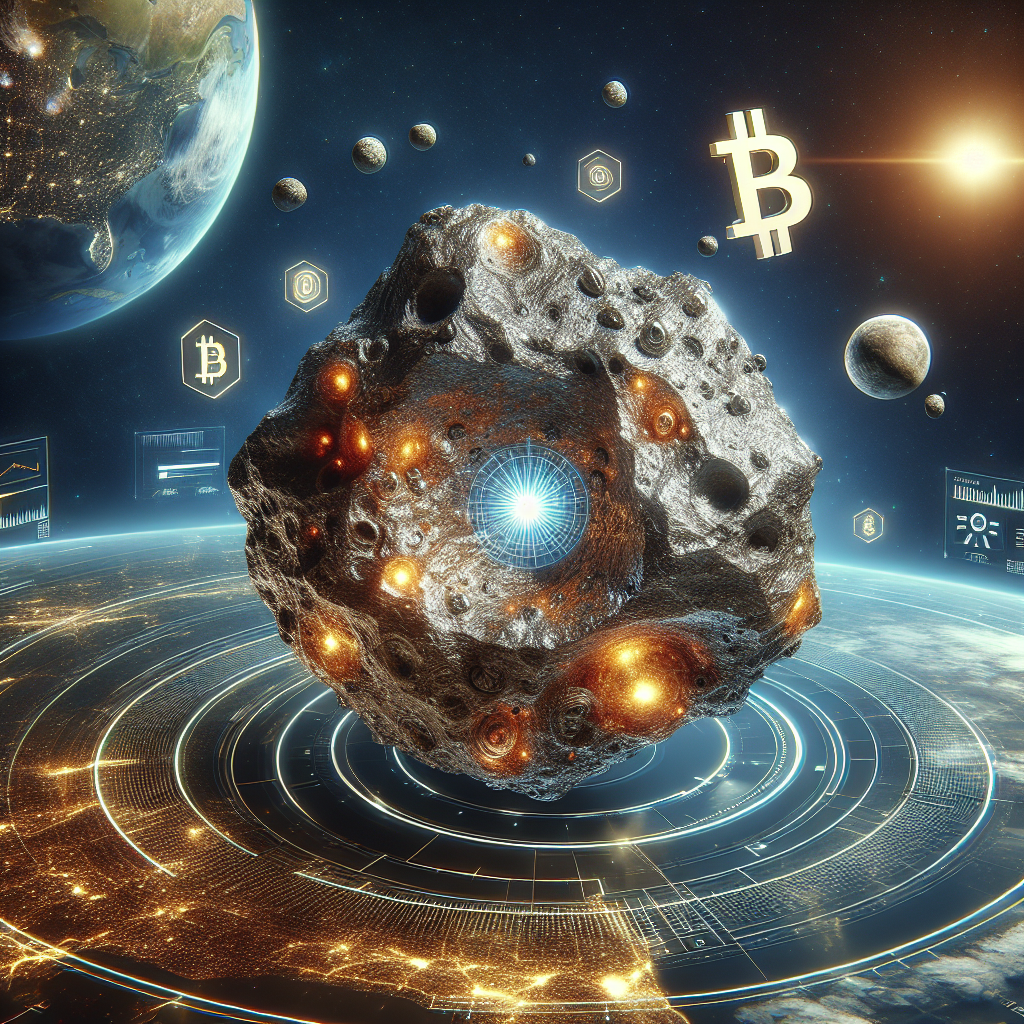
Bitcoin vs Gold: Why a $10 Quintillion Discovery Matters
For centuries, gold has been considered the ultimate store of value. From ancient civilizations to modern central banks, this precious metal has symbolized wealth, stability, and economic power. But in the digital age, a new contender has emerged: Bitcoin, the decentralized cryptocurrency that is rewriting the rules of money.
Now, a shocking astronomical discovery may upend the gold narrative entirely—forcing investors and institutions alike to rethink what they really value in a store of wealth. A recent revelation: a massive asteroid packed with precious metals, possibly worth over $10 quintillion, raises a critical question—could Bitcoin actually be more scarce and reliable than gold?
The $10 Quintillion Asteroid That Could Crash Gold Prices
NASA’s Psyche mission is scheduled to explore a unique, metal-rich asteroid called 16 Psyche. Located between Mars and Jupiter, this space rock isn’t your typical celestial object; it’s believed to be composed largely of iron, nickel, and a jaw-dropping amount of gold and other precious metals.
Scientists estimate the combined value of 16 Psyche to be in excess of $10 quintillion—yes, that’s a 10 followed by 18 zeros. To put it into perspective, that’s many times more than the total value of the entire global economy.
What Would Happen If This Gold Hit the Market?
If even a fraction of 16 Psyche’s enormous wealth were mined and brought back to Earth, it could have a dramatic—and possibly catastrophic—impact on gold prices. Here’s why:
- Increased supply would dilute scarcity, driving the price of gold downward.
- Market confidence could erode if gold is no longer perceived as rare.
- Massive volatility could make gold a less dependable hedge against inflation and economic instability.
This illustrates a crucial flaw in gold’s status: while it is physically finite on Earth, it is not absolutely scarce on a cosmic level. New discoveries like 16 Psyche could disrupt global markets in ways we’ve never seen before.
📊 Do you want a simple way to tell which Bitcoin news actually moves the market—and which is just noise? Download our free, no-fluff guide—it gives you a 5-minute system to cut the noise and think clearly. It’s lean, actionable, and built to help you identify what matters—so you can stop second-guessing the headlines and start making smarter moves. 👉 Get the guide
Bitcoin: Programmatic Scarcity Backed by Code
Unlike gold, Bitcoin’s scarcity isn’t dependent on physical limitations—it’s enforced by mathematical certainty. Only 21 million bitcoins will ever exist, and the protocol behind this cap is hardcoded and enforced by a decentralized global network.
This built-in limit makes Bitcoin:
- Impossible to inflate—no central authority can print more BTC.
- Predictably scarce—investors know exactly how much supply will exist and when it will be available.
- Resistant to unexpected supply shocks—there’s no “Psyche-like” discovery in Bitcoin’s future.
In a world where even gold can suddenly become abundant, Bitcoin offers something much rarer: mathematical scarcity that no individual, government, or extraterrestrial body can alter.
Why Scarcity Matters in a Store of Value
One of the defining characteristics of a good store of value is scarcity—an asset must be rare enough to hold or grow its value over time. Let’s compare gold and Bitcoin on multiple key attributes:
Physical vs Digital Scarcity
- Gold’s scarcity is relative and threatened by new discoveries or technological breakthroughs in mining (on or off-Earth).
- Bitcoin’s scarcity is absolute and predetermined; unless the entire global network agrees to change the code (unlikely), supply won’t change.
Portability
- Gold is heavy, difficult to transport, and requires storage facilities.
- Bitcoin is lightweight and borderless, able to be moved globally in seconds with little to no cost.
Divisibility
- Gold is less easily divisible without losing value or requiring additional refining.
- Bitcoin can be divided into 100 million satoshis per BTC, allowing for microtransactions and more flexibility in use.
Institutional Confidence and the Shift Toward Bitcoin
While gold has enjoyed millennia of trust, the tides are shifting. Institutions from BlackRock to Fidelity are entering the Bitcoin space. Countries like El Salvador are even making it legal tender. This growing adoption highlights Bitcoin’s evolution from a fringe investment to a mainstream store of value.
Meanwhile, gold is facing an identity crisis. If a single asteroid can change the entire market dynamic for gold, how future-proof is gold as a foundation for long-term wealth?
Environmental and Economic Considerations
Both gold mining and Bitcoin mining have environmental impacts, but the dynamics are evolving:
- Gold mining often results in deforestation, habitat destruction, and toxic chemical leaks like mercury and cyanide.
- Bitcoin mining, initially criticized for energy use, is increasingly powered by renewable energy and is being integrated into grids for load balancing and demand response.
Moreover, extracting gold from space would be a carbon-intensive, high-risk, high-cost endeavor. By contrast, Bitcoin’s open-source protocol requires no physical extraction, just secure computation—a process that becomes more efficient as technology improves.
The Final Verdict: Bitcoin’s Scarcity Is in a League of Its Own
The possibility of suddenly doubling or tripling the global gold supply through asteroid mining undermines the metal’s long-standing reputation as a secure store of value. Whether or not 16 Psyche is ever mined, the mere knowledge that such a discovery exists changes how investors perceive gold’s reliability.
Bitcoin, on the other hand, offers predictable, unchangeable scarcity baked into its very essence. It’s immune to the kind of external supply shocks that could devastate traditional commodity markets.
Key Takeaways
- Gold’s scarcity is vulnerable to technological advancement and exploration.
- Bitcoin offers fixed supply and cannot be duplicated or discovered unexpectedly.
- The $10 quintillion asteroid is a wake-up call for investors to diversify and consider digital assets with verifiable scarcity.
As we journey further into the 21st century, digital assets like Bitcoin aren’t just tech fads—they’re fundamental shifts in how we define and protect wealth. The golden age may not be over, but the Bitcoin era is undoubtedly here.